
Sensex ended strong, Tata Steel, HUL climb higher.

Global rating agency Fitch has revised upwards India's growth projection to 6 from 5 per cent for the current fiscal and said the recent election results should provide additional confidence and spur growth.

China is estimated to grow at 6.7 per cent in 2016.

Several mutual funds (MFs) have recently approached the Reserve Bank of India (RBI) as they renew efforts to increase their overseas investment limit. In June 2022, the capital markets regulator Securities and Exchange Board of India (Sebi) permitted MFs to invest in foreign stocks within the aggregate mandated limit of $7 billion after a correction in stocks. One of the proposals shared with the RBI is to link MFs' foreign investment limit to the country's foreign exchange reserves.

India's growth in the last three financial years has averaged just 1.9%. It is natural to project rapid growth from this low base. Crucial to that would be the assumption that the economy has suffered no lasting damage from the pandemic, observes T N Ninan.

The global recovery is expected to be asynchronous and divergent between advanced and emerging market economies, the IMF said on Tuesday, noting that policymakers should take early action and tighten selected macroprudential policy tools while avoiding a broad tightening of financial conditions. "Extraordinary policy measures have eased financial conditions and supported the economy, helping to contain financial stability risks," the International Monetary Fund (IMF) said in its Global Financial Stability report released ahead of the Spring meeting of the global lender and the World Bank. However, actions taken during the pandemic may have unintended consequences such as stretched valuations and rising financial vulnerabilities, it said.
Revising its economic outlook, International Monetary Fund (IMF) today marginally brought down India's growth rate projections to 5.6 per cent for this fiscal and 6.3 per cent for the next financial year.

Prime Minister Narendra Modi on Thursday said his government is using all channels including diplomatic to bring back high-profile economic offenders, leaving them with no option but to return to the country. Speaking at a symposium on credit flow and economic growth, he asked banks to support wealth and job creators with proactive lending while promising to stand by any loans given in right earnest. "In our attempt to bring back fugitive (economic offenders), we relied on policies and law and also used diplomatic channels.
The Shanghai Stock Exchange has registered maximum fall (56 per cent) from its peak, while the benchmark index of the Bombay Stock Exchange dipped by as much as 40 per cent and the Manila Stock Exchange dropped by 39 per cent, registering the third largest fall. The report added that 'having lost one fifth to one third of their value, equity assets would appear to have greater upside rather than down side prospects.

Global trends and trading activity of foreign investors would largely dictate terms in the equity markets this week amid a lack of major domestic triggers, analysts said. Markets may face near-term consolidation due to elevated valuations, they noted. "While the previous week was predominantly shaped by developments in the US Federal Reserve policy, attention will now shift to the Bank of Japan's policy decision on December 19," Santosh Meena, Head of Research, Swastika Investmart Ltd, said.

WPI inflation fell to a 5-year low of 3.74 per cent while the retail inflation was at 7.8 per cent in August.

'As China's reopening euphoria fizzled out on the back of some disappointing economic data, we saw inflows coming back to India with full force in the past 3-4 months.'

'What my Labour government will seek with India is a relationship based on our shared values of democracy and aspiration. That will seek a free trade agreement (FTA), we share that ambition, but also a new strategic partnership for global security, climate security, economic security'

Do not, however, enter expecting quick returns.
The Reserve Bank of India's tight monetary policy is expected to moderate India's economic growth rate to 8.1-8.6 per cent in 2008, against 8.5-9 per cent in 2007, Global rating agency Standard and Poor's said on Wednesday.

tailwinds of a remarkable year and handsome investor returns, Indian equities are set for an eventful journey in 2024, with a slew of local and global cues -- varying from interest rates to Lok Sabha polls to geopolitical happenings. Analysts are of the view that the bull run in the domestic equity market will continue, and over the next 3-6 months, the benchmark indices -- Sensex and Nifty -- could climb up to 7 per cent. In 2023, the 30-share BSE Sensex jumped 11,399.52 points or 18.73 per cent, and the NSE Nifty climbed 3,626.1 points or 20 per cent.
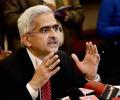
The uncertainty created by the jump in COVID-19 infections and localised lockdowns prompted RBI Governor Shaktikanta Das and other members of the rating setting panel MPC to unanimously vote for status quo in interest rates and an accommodative policy stance to support growth, as per minutes of the meeting released on Thursday. "The need of the hour is to effectively secure the economic recovery underway so that it becomes broad-based and durable," the Governor said during the three-day meeting of the Monetary Policy Committee (MPC) which ended on April 7. The renewed jump in COVID-19 infections in several parts of the country and the associated localised and regional lockdowns add uncertainty to the growth outlook, he observed, as per the minutes of the meeting released by the central bank.

India's manufacturing sector activity rose to a 13-month high in December, supported by healthy inflows of new business and strong demand conditions, according to a monthly survey. The seasonally adjusted S&P Global India Manufacturing Purchasing Managers' Index (PMI) stood at 57.8 in December, up from 55.7 in November, as business conditions improved to the greatest extent in over two years. The December PMI data pointed to an improvement in overall operating conditions for the 18th straight month.

Buoyed by healthy farm output and narrowing current account deficit, India is the seventh most economically confident country in the world, a study by global research firm Ipsos has said.

Prospective buyers must make a well-considered decision regarding whether this is the right time to buy a house, particularly with home loan rates at near-peak levels, and the risk of job losses looming in many sectors.

With the new Indian government showing signs of economic reforms and brings in transparency in governance, the World Bank feels that the world's third-largest economy could achieve a growth rate of 5.5 per cent this year as compared to 4.7 per cent last year.

The Indian economy, severely hit by the coronavirus pandemic, is projected to contract by a massive 10.3 per cent this year, the International Monetary Fund said on Tuesday. However, India is likely to bounce back with an impressive 8.8 per cent growth rate in 2021, thus regaining the position of the fastest growing emerging economy, surpassing China's projected growth rate of 8.2 per cent, the IMF said in its latest 'World Economic Outlook' report.

The Economic Survey said that a number of indicators -- GDP, IIP, credit, investment and capacity utilisation, point to a deceleration in real activity since first quarter of 2016-17 and a further deceleration since the third quarter.
.jpg)
Moody's became the first rating agency to retain the sovereign rating of Baa3 for the country after the rupee dived below 63 to the dollar, on Monday.

Moody's on Friday slashed India's GDP growth projections for 2022 to 7 per cent from 7.7 per cent earlier as the global slowdown and rising domestic interest rates will dampen economic momentum. This is the second time that Moody's Investors Service has cut India's growth estimates. In September, it had cut projections for the current year to 7.7 per cent from 8.8 per cent estimated in May. "For India, the 2022 real GDP growth projections have been lowered to 7 per cent from 7.7 per cent.

Gita Gopinath, the IMF's Indian-American chief economist has been promoted as its First Deputy Managing Director recognising her exceptional intellectual leadership in helping the global economy and the Fund to navigate the "twists and turns" of the "worst economic crisis of our lives". Gopinath would replace Geoffrey Okamoto who plans to leave the International Monetary Fund early next year, Kristalina Georgieva, IMF's managing director announced on Thursday. Gopinath, who was scheduled to return to her academic position at Harvard University in January 2022, has decided to stay, she said. Gopinath, 49, has served as the first female chief economist of the Washington-based global lender for three years.

Following another disappointing year in 2014, developing countries should see an uptick in growth this year, boosted in part by soft oil prices, a stronger US economy, continued low global interest rates, and receding domestic headwinds in several large emerging markets, it added.

India's services sector activity eased in August but growth rates for new orders remain elevated, as services firms indicated the sharpest upturn in new export business which acted as a catalyst for firms to expand their workforces as well as output, a monthly survey said on Tuesday. Despite falling from 62.3 in July to 60.1 in August, the seasonally adjusted S&P Global India Services PMI Business Activity Index indicated one of the strongest increases in output seen since mid-2010. For the 25th straight month, the headline figure was above the neutral 50 threshold.

Rising oil prices and firming up of global and domestic food prices are likely to have a significant impact on inflation outlook in 2011, a top RBI official said.
Most of the Asia-Pacific economies would be cushioned by healthy foreign exchange reserves in the last quarter of the current calendar year, global ratings agency, Standard & Poor, said in a report.

'Given the worries about sluggish growth, rising interest rates and likely volatility, it's quite logical to infer that the SIP route could be the preferred way of investing.'

According to the TeamLease Employment Outlook Survey for the next six months (October 2014 - March 2015), global macroeconomic trends and domestic demand have put business and employment sentiment on a fast paced upward trajectory.

World Bank says India has bright prospects.

Stating that an economic recession gripped global economy following the lockdowns due to COVID-19 pandemic, Fitch Ratings on Friday said the initial disruptions to regional manufacturing supply chains in China have now broadened to include local discretionary spending and exports.

Silver, which is currently trading at Rs 68,453 per kilogram, has appreciated 21.7 per cent over the past three months. Investors, however, shouldn't get carried away by its recent performance and put their money in it. Instead, they should evaluate its pros and cons and then take a considered decision based on their risk appetite.

Indian equity markets have a limited upside potential in the near-term as they negotiate the ensuing cyclical slowdown, wrote analysts at Nomura in a recent coauthored report led by Saion Mukherjee, their managing director and head of equity research for India. He, however, believes that the foundations are in place for sustainable growth over the medium-to-long term, and hence suggests a 'buy on dips' strategy to equity investors. As an investment strategy, Nomura prefers domestic-oriented sectors and companies over exporters, and prefers stocks that provide valuation comfort. Industrials and banks are their overweight sectors, while IT services and consumer discretionary are their underweight sectors.

S&P Global Ratings has upgraded its long-term ratings on Tata Motors to speculative grade 'BB' with stable outlook on earnings improvements and potential deleveraging. The ratings agency had earlier placed Tata Motors in 'BB-'. As per S&P ratings, a BB grade is less vulnerable in the near-term but faces major ongoing uncertainties to adverse business, financial and economic conditions.

India's gold demand rose 8 per cent annually to 136.6 tonne in the March quarter helped by a strong economic environment despite prices touching historic highs, according to the World Gold Council. The aggressive gold buying by the Reserve Bank of India (RBI) also contributed to the rise in demand. India's gold demand in value terms rose 20 per cent on an annual basis to Rs 75,470 crore during the January-March period of this year on volume growth as well as a rise in quarterly average prices by 11 per cent.

India appears poised to sustain its growth in a more durable way than before with the economy carrying the momentum from FY23 into the current fiscal year, the Annual Economic Review for 2022-23 released by the finance ministry on Thursday said. However, the report cautioned that escalation of geopolitical stress, enhanced volatility in global financial systems, sharp price correction in global stock markets, a high magnitude of El-Nino impact, and modest trade activity and FDI inflows, are factors that could constrain the pace of growth. "Should these developments deepen and dampen growth in the subsequent quarters, the external sector may challenge India's growth outlook for FY24," the finance ministry said.
 © 2026 Rediff.com - Advertise with us - Disclaimer - Privacy Policy - Sitemap - Feedback - About us - Terms of use - Grievances